
Amazon Seller Fulfilled Prime (SFP) lets qualified Professional sellers show the Prime badge on products they ship themselves, from their own location or a third-party warehouse, instead of sending inventory to Amazon. In exchange, you must meet Amazon’s Prime delivery-speed and performance standards. This guide covers how SFP works in 2026, the current requirements (including the tighter speed rules Amazon introduced in July 2026), costs, using a 3PL, and how SFP compares with FBA.
What is Amazon Seller Fulfilled Prime (SFP)?
SFP is an Amazon program that allows sellers to display Prime branding on self-fulfilled (merchant-fulfilled) offers. Prime customers get fast, free delivery and free returns, while you keep control of your inventory, storage location, packaging, and carriers.
Because Prime offers are trusted by shoppers and help you compete for the Featured Offer (Buy Box), SFP can improve visibility and conversion, but only if you consistently deliver on time. Amazon evaluates SFP offers by size tier (standard, oversize, and extra-large) and reviews your performance weekly, Sunday through Saturday.
Amazon Seller Fulfilled Prime Requirements (2026)
SFP requirements come in three stages. Amazon updates its thresholds periodically, so always confirm the latest numbers in Seller Central before you apply.
1. Prequalification
- A Professional selling account and a US default shipping address.
- At least 100 self-fulfilled packages in the past 90 days.
- Cancellation rate below 2.5%.
- Valid tracking rate above 95%.
- Late shipment rate below 4%.
2. The 30-day Prime trial
- Ship Prime trial orders with a dedicated Prime shipping template that offers one-day and two-day delivery (the Prime badge is not shown during the trial).
- Fulfill at least 100 packages from Prime trial orders.
- On-time delivery rate of at least 93.5%.
- Valid tracking rate of at least 99%.
- Seller-initiated cancellation rate below 0.5%.
3. Ongoing performance and delivery speed
After you are enrolled, you must keep meeting the on-time delivery, valid tracking, cancellation, and delivery-speed requirements, with nationwide delivery coverage across the contiguous US. Delivery speed is measured as the share of Prime page views that show a fast delivery promise for your offers. Effective July 6, 2026, Amazon raised the speed thresholds:
| Size tier | One-day | Two-day | Within five days |
|---|---|---|---|
| Standard-size | 40% | 75% | 90% |
| Oversize | 15% | 45% | 80% |
| Extra-large | No one-day threshold | 25% | 60% |
The transition grace period for these speed rules ran through October 17, 2026. If you keep missing requirements, Amazon can disable your Prime offers and remove you from the program; you can re-enroll later by prequalifying and completing a new trial. To protect your metrics during peaks, use the Control Prime order volume setting to cap daily same-day, one-day, and two-day orders, and check your SFP performance dashboard in Seller Central every week.
😍 How to Prepare for Amazon Prime Day?
How Does Amazon SFP Work?
When a Prime customer orders one of your SFP offers, you (or your 3PL) pick, pack, and ship it with an Amazon-integrated carrier. Buying labels through Amazon Buy Shipping adds account-health protections, such as Amazon covering the claim when a customer reports a package as not delivered. Amazon handles post-order customer service for Prime items, including returns, refunds, and adjustments, and automatically authorizes returns requested within the return window. You still answer pre-order customer questions.
SFP is especially useful for products that are bulky, fragile, high-value, or not eligible for FBA, such as furniture, mattresses, large home décor, or jewelry, and for sellers who want to keep inventory flexible across several sales channels.
How to Enable Amazon Seller Fulfilled Prime?
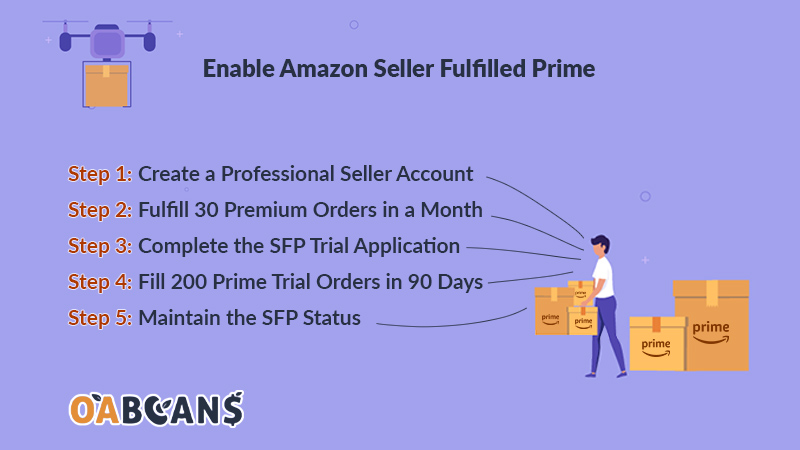
Step 1 – Make sure you have a Professional selling account and a US default shipping address. New sellers create a Professional account first; existing sellers log in to Seller Central.
Step 2 – Check whether you prequalify on the Seller Fulfilled Prime trial registration page. If you don’t yet, track your self-fulfilled volume, cancellation, valid tracking, and late shipment rates in Business Reports and the Account Health dashboard until you meet the thresholds above.
Step 3 – Register for the trial and set up the Prime shipping template with one-day and two-day delivery options for the regions you can reliably reach.
Step 4 – Complete the 30-day trial while meeting the trial performance requirements (100+ trial packages, 93.5%+ on-time delivery, 99%+ valid tracking, and under 0.5% cancellations).
Step 5 – Once enrolled, choose which products carry Prime and monitor the SFP performance dashboard weekly to stay in good standing.
What is Amazon FBM & How it Works?
Seller Fulfilled Prime Costs and Shipping Rates
Amazon doesn’t list a separate SFP enrollment fee, but you need a Professional selling plan ($39.99/month) and you pay the normal referral fee on every sale (around 8% to 15% in most categories). Shipping is your cost: Prime orders ship free to the customer, so your margin depends on carrier rates, package size and weight, delivery zones, packaging, and, if you outsource, your 3PL’s pick-and-pack and storage fees.
Before enrolling a product, compare your all-in SFP cost per order with FBA. Our breakdown of Amazon FBA fees and the Amazon FBA profit calculator make that comparison easier.
Using a 3PL for Seller Fulfilled Prime
You don’t need your own warehouse for SFP. Amazon allows inventory to be kept at home or with a third-party logistics (3PL) provider, and many sellers use a 3PL with several warehouses to reach more customers within one or two days. When comparing SFP 3PL providers, check:
- Network coverage: the number and location of warehouses relative to your customers.
- Cutoff times and weekend operations: late order cutoffs and Saturday shipping make speed targets easier to hit.
- Amazon integration: Buy Shipping support and reliable valid-tracking uploads.
- Pricing: pick-and-pack, packaging, storage, and minimum monthly fees.
- Track record: on-time delivery results for other SFP clients.
Pros & Cons of Seller-Fulfilled Prime
Pros
- Access to Prime shoppers and Prime branding on self-fulfilled offers.
- Full control over your inventory, with no need to ship stock into Amazon.
- No FBA fulfillment, storage, or inbound placement fees on SFP orders.
- Better economics for bulky or heavy items that carry high FBA fees.
- A way to offer Prime on products that aren’t eligible for FBA.
- Prime offers compete strongly for the Featured Offer (Buy Box).
Cons
- You pay for free, fast shipping, which can be expensive for low-priced items.
- Strict and rising delivery-speed requirements, including one-day coverage targets.
- Missed metrics can remove the Prime badge or your enrollment.
- You need disciplined daily operations, or a capable 3PL.
Because of these costs, SFP usually suits brand owners and sellers with healthy margins or oversized products. Most online arbitrage sellers, who resell many different low-to-mid-priced products, find FBA simpler and more cost-effective, and use self-fulfillment (FBM) only for selected items.
Read More: How to Start Amazon FBA Business?
SFP vs. FBA: Which One Is Better?
| Factor | Seller Fulfilled Prime (SFP) | Fulfillment by Amazon (FBA) |
|---|---|---|
| Storage and shipping | You or your 3PL store, pack, and ship | Amazon stores, packs, and ships |
| Main costs | Shipping labels, packaging, your warehouse or 3PL | FBA fulfillment fees, storage fees, inbound placement fees |
| Customer service and returns | Amazon handles post-order service for Prime items; returns come back to you | Amazon handles everything |
| Getting started | Prequalification plus a 30-day trial | Open to sellers who meet FBA inbound and prep requirements |
| Ongoing risk | Losing Prime if speed or on-time metrics slip | Capacity limits, fee changes, and inbound delays |
| Best for | Bulky, fragile, or high-margin products; brand owners | Most resellers, including online arbitrage sellers |
Since January 1, 2026, Amazon no longer offers its own FBA prep and item-labeling service in the US, so FBA sellers must prep inventory themselves or use a third-party prep center. Factor that into any SFP-versus-FBA cost comparison.

Whichever fulfillment model you choose, a steady supply of profitable products is what drives growth. Many FBA sellers use online arbitrage leads to find products to resell without spending hours on research or supplier hunting.
Final Thoughts
Amazon Seller Fulfilled Prime lets you earn the Prime badge while shipping from your own location or a 3PL. It can pay off for bulky, fragile, or high-margin products, but the 2026 speed thresholds are demanding, so test your costs and delivery coverage before you enroll, and keep FBA for products where it is simpler and cheaper.
FAQ
What is the difference between Amazon SFP and FBA?
With SFP, you store and ship Prime orders yourself (or through a 3PL). With FBA, Amazon stores your inventory in its fulfillment centers and ships orders for you.
Do you need your own warehouse for Amazon SFP?
No. Amazon allows SFP inventory to be stored at home, in your own warehouse, or with a third-party logistics provider, as long as you meet the Prime delivery-speed and performance requirements.
Is SFP available to all Amazon sellers?
Any US-based Professional seller can apply, but you must first prequalify (at least 100 self-fulfilled packages in 90 days with good cancellation, tracking, and late-shipment rates) and then pass a 30-day trial.
What shipping carriers can you use for Seller Fulfilled Prime?
You can use Amazon-integrated carriers. Buying labels through Amazon Buy Shipping is recommended because it provides extra account-health protections and reliable tracking.
How do returns work with Seller Fulfilled Prime?
Prime items include free returns for domestic Prime customers. Amazon handles post-order customer service for SFP orders and automatically authorizes returns requested within the return window.
What are the SFP delivery-speed requirements in 2026?
Since July 6, 2026, standard-size SFP offers need a one-day delivery promise on 40% and a two-day promise on 75% of Prime page views, with lower thresholds for oversize and extra-large items. Check your SFP dashboard for the current targets.
What happens if you fail SFP performance metrics?
Amazon emails you about unmet requirements. Continued failures can lead to your Prime offers being disabled and removal from the program; you can re-enroll by prequalifying and completing a new trial.
Is SFP better than FBA for oversized or fragile items?
Often, yes. SFP can be more cost-effective for large or fragile items that carry high FBA fees, provided you can still meet the speed thresholds for their size tier.