
Amazon Lending gives eligible US sellers access to business financing (term loans, a merchant cash advance, lines of credit, and SBA loans) through third-party providers, with offers shown directly in Seller Central. Below we explain how Amazon seller loans work in 2026, who qualifies, how to apply, how repayment works, and what to consider before you borrow.
What is the Amazon Lending Program?
Amazon Lending is Amazon’s financing program for small and medium-sized businesses that sell in its store. It first launched in 2011, when Amazon began offering short-term loans to invited sellers. Today, in the US, Amazon connects eligible sellers with financing providers such as Lendistry, Parafin, QuickBooks Capital, Uncapped, Slope, and iBusiness Funding, which review your Amazon selling data to make an offer.
Because providers can see your sales history and performance on Amazon, the process is usually faster and simpler than a traditional bank loan. Applying through Amazon Lending does not affect your personal credit, according to Amazon.
Why Should Sellers Use Amazon Lending?
Bank loans can take weeks and often don’t account for how an Amazon business earns money. Here is why many sellers look at Amazon Lending first:
- Speed: Amazon says decisions usually come within one to three business days, and approved funds are typically disbursed within about two business days.
- Simple application: You share your Amazon selling data with the provider, so the application usually takes minutes, although providers may request extra documents.
- Inventory funding: You can stock up ahead of peak seasons like Q4 or buy larger quantities of proven products.
- Choice of products: Depending on your offers, you can choose between term loans, a merchant cash advance, lines of credit, or SBA loans.
- No impact on personal credit to apply: According to Amazon, applying doesn’t affect your personal credit.
Rates, fees, and terms are set by each provider and vary by seller, so always compare the total cost of an offer with other financing before you accept.
How to Get Funds from Amazon Lending?
Amazon Lending offers are only shown to eligible sellers. To access these funds, you must maintain an active Amazon account in good standing, have a solid sales record and meet Amazon’s customer performance metrics. If you are invited, here are the steps you should follow:
Check for an invitation:
At first step, log in to your Seller Central dashboard and look for an Amazon Lending invitation banner or a notification.
Review the offer details
After receiving this banner, click on it to read the financing offer details, such as the product type, loan amount, interest rate and repayment terms. In the US, offers can include these main types of financing (plus SBA 7(a) loans through iBusiness Funding):
- Term Loan, which is a lump-sum loan with a fixed interest rate, repaid through equal monthly payments.
- Merchant Cash Advance (MCA) is an advance of funds that is automatically deducted as a set percentage of your future Amazon sales.
- Line of Credit, which is a flexible credit line with a specific limit, where you only pay interest on the amount you borrow and can draw funds up to your approved limit during a given period.
Prepare your documents
Before applying, make sure you have all the required documents ready. For example, recent bank statements, identification, and financial records are some essential documents. These are important and will help you complete your application smoothly.
Apply through Amazon Lending partners:
Now it’s time to click on Start Application and send your request to Amazon’s designated lending partner to access the funds. Current US providers include Lendistry, Parafin, QuickBooks Capital, Uncapped, Slope, and iBusiness Funding. You agree to share your Amazon selling data with the provider and finish the application on its site.
Approval and funding
Amazon says decisions are usually made within one to three business days. If you’re approved and accept the terms, funds are typically disbursed to your account within about two business days. Providers may ask for extra documents, which can add time.
Repayment and monitoring
After receiving the funds, you must carefully manage your repayments. Term loans are repaid in scheduled installments (weekly, biweekly, or monthly, depending on the provider), while a merchant cash advance is repaid as a fixed percentage of your future sales. Payments are collected automatically, so keep enough funds available and your Amazon sales steady so payments go through. Keep your Amazon account health strong, too, because a deactivated account can disrupt both sales and repayments.
When using Amazon Lending, you should make informed and strategic decisions to ensure the financing truly benefits your business. It’s important to know and follow some best practices.
- Compare the costs before accepting any loan. Carefully review the total borrowing cost, including interest rates or fees, and compare them with other financing options available in the market.
- Only take a loan with a clear business purpose. For example, investing in expanding your inventory or marketing efforts. This helps ensure you get a positive return from the funds you borrow.
- keep your seller metrics strong, because your eligibility for Amazon Lending depends on the health and performance of your Amazon account.
If the Amazon Lending offer doesn’t fit your needs, consider other financing options such as the Amazon Community Lending Program, independent fintech lenders, or traditional bank and SBA loans.
What Are the Requirements for Getting a Loan from Amazon?
Amazon doesn’t publish a fixed minimum sales figure or time-in-business rule for Amazon Lending. Offers are based on your Amazon data, and the main factors are:
- A US-based business with a Professional selling account.
- A proven record of sales, ideally with steady or growing revenue.
- Strong customer satisfaction and account health metrics (for example, low order defect and return rates).
- An account in good standing, without serious policy or intellectual property complaints.
- Each provider’s own underwriting rules, which may include extra documents such as bank statements.

The best way to become eligible for Amazon Lending is to follow Amazon’s policies and build a healthy account from the start. A growing sales history, low return rates, and positive customer feedback show providers that your business is stable, which makes an offer more likely.
The options and providers described here apply to US-based sellers. Financing programs in other Amazon marketplaces differ, so check Seller Central in your marketplace for what is available to you.
Types of Business Loans That Amazon Lending Offers
Amazon Lending has expanded from a single invite-only loan into several financing products from different providers. Here is how the main US options compare, based on Amazon’s program page:
| Product | Provider(s) | How it works |
|---|---|---|
| Term loan | Lendistry (Amazon Community Lending), Parafin, QuickBooks Capital, Uncapped | A lump sum repaid on a set schedule. Parafin terms run 6 to 24 months; QuickBooks Capital loans range from $1,500 to $250,000. |
| Merchant cash advance | Parafin | No interest; a fixed capital fee repaid as a set percentage of your future sales. |
| Line of credit | Slope, Uncapped | Draw funds as needed up to your limit (Slope offers up to $5M) and pay a fixed rate on what you use. |
| SBA 7(a) loan | iBusiness Funding | Government-backed loan with a variable rate of prime plus 1.5% to 6.5%, depending on loan size. |
Merchant Cash Advance (MCA)
With a merchant cash advance (offered through Parafin), you receive a lump sum upfront. Instead of fixed payments, repayment is made automatically as a set percentage of your future sales, and instead of interest you pay a fixed capital fee that is shown before you accept. The main benefit is flexibility, because payments rise and fall with your sales.
But, MCAs often come with high fees, leading to a higher effective APR. So, this type is ideal for sellers who need quick access to funds and have consistent monthly sales.
Amazon Community Lending Program
Through Amazon Community Lending, Amazon works with Lendistry to offer term loans to small and medium-sized businesses. Amazon says these loans carry a fixed capital fee with no interest, no collateral, and no late fees, are repaid in biweekly payments, and that on-time payments can help build business credit. It is a useful option for sellers who struggle to get approved by traditional banks.
Amazon Business Line of Credit
A line of credit (offered through providers such as Slope and Uncapped) lets you draw money as you need it up to your approved limit, and you only pay for what you draw. It is well suited to managing working capital and seasonal inventory purchases.
Business Term Loans
Term loans provide a fixed amount of money that is repaid over a set period through scheduled payments. They suit planned investments such as expanding inventory or launching new product lines.
SBA 7(a) Loans
For larger or longer-term needs, iBusiness Funding offers SBA 7(a) loans through Amazon Lending. They usually take longer to process and may require more documentation, but SBA loans can offer longer terms than short-term seller financing.
How to Apply for Amazon Lending (Step by Step)
When your business’s financial survival depends on a certain amount of money, Amazon loans can be the first thing that comes to your mind. Although the process is pretty straightforward, it is essential to do it right and complete all the steps.
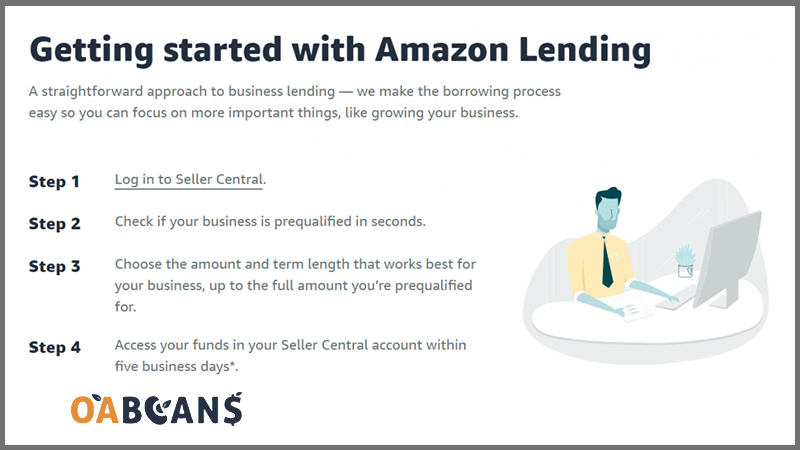
Here is how:
- Log in to Seller Central and check for a financing invitation (a banner or notification), or open the Amazon Lending page. Offers are only visible to eligible sellers.
- Review each offer: product type, amount, fees or rate, and repayment terms. You can choose up to the full eligible amount.
- Click Start Application and agree to share your Amazon selling data with the provider.
- Complete the application on the provider’s site and submit it.
- Receive a decision (usually within one to three business days). If you accept the terms, funds are typically disbursed within about two business days.
Don’t worry if you don’t see an offer yet. Eligibility can change as your sales grow and your account health and customer metrics improve, so keep building your business and check back regularly.
Why Don’t Banks Loan Money to the Amazon Sellers?
Let’s remember: banking is an ancient practice (that still works), and the nature of some of its rules and regulations just can’t be aligned with modern businesses like Amazon FBA. Many banks in the US and Europe are still conservative, and the idea of FBA, online arbitrage, drop shipping, etc., is just outside their area of expertise. To lend you money, banks need to make sure you can pay it back no matter what. Although it seems unfair, a bank won’t give you (or your business) money unless you already have money.
Many banks need help finding the right reason to ensure a small business owner on Amazon will make enough profits to pay them back. So they won’t give them loans. Also, many Amazon sellers can’t get along with repayment terms, agreements, and relatively high-interest rates bank-paid loans.
Final Thoughts
Amazon Lending can be a fast, convenient way to fund inventory and growth, even for smaller sellers, because providers base offers on your real Amazon performance. Before you accept any offer, compare its total cost with other options, borrow only for a clear purpose with a positive return (for example, proven inventory), and make sure your cash flow can cover repayments. For online arbitrage sellers, our guide on how much capital you need for online arbitrage can help you decide how much to borrow, and a reliable flow of profitable deals from online arbitrage leads helps turn that capital into sales.
FAQs