
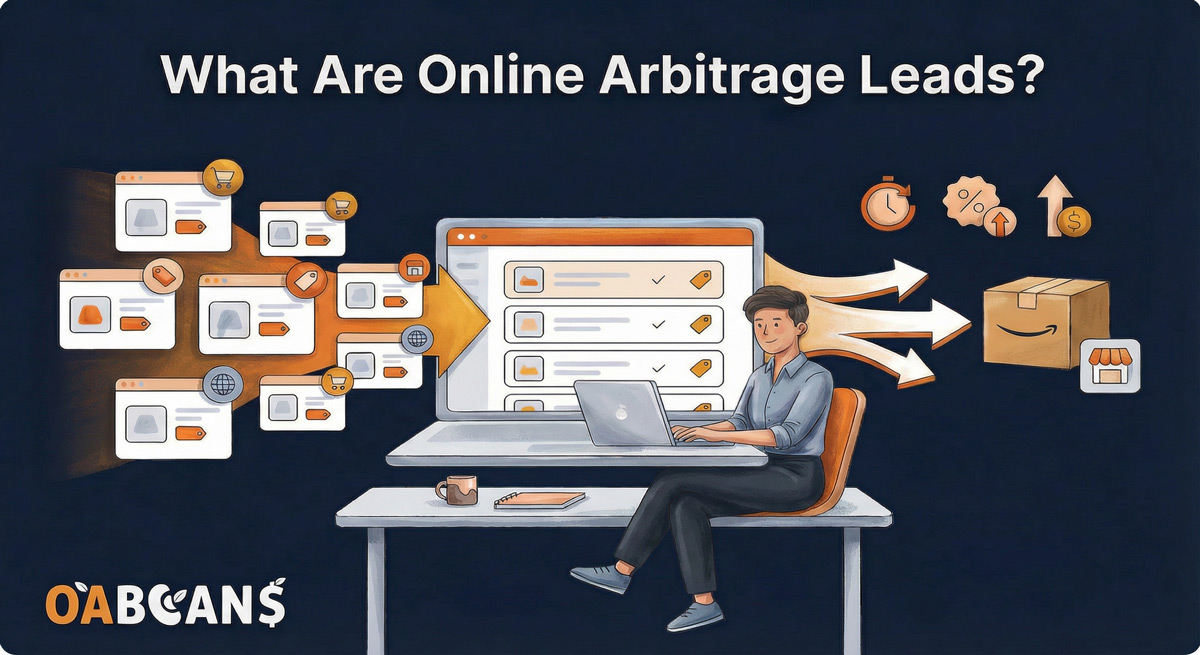
What Are Online Arbitrage Deals and How Do They Work?
Imagine opening your laptop, getting some straightforward links to the exact products you need for your OA business. Well, not just need, but products you’re able to trust for the profitability, speed and competitiveness.
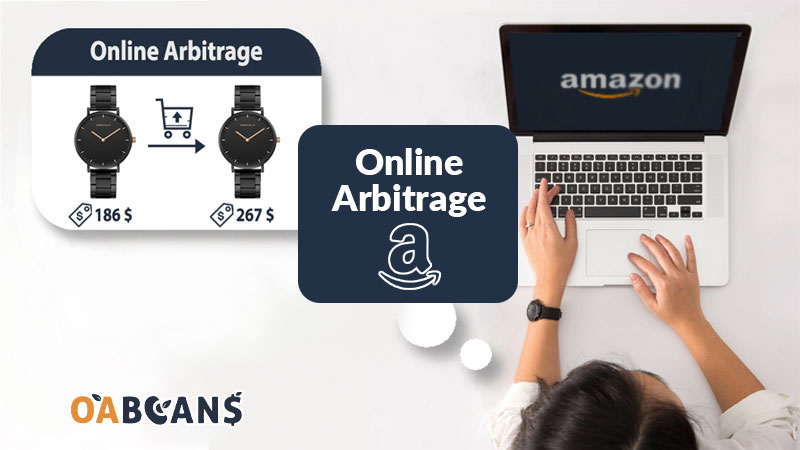
That is the core idea behind online arbitrage deals. An online arbitrage deal is a product that has been researched in advance and identified as potentially profitable to buy from an online retailer and resell on Amazon or another marketplace. Each deal usually includes key information such as source price, selling price, fees, sales rank, and estimated profit.
Difference Between Online Arbitrage and Retail Arbitrage
While online arbitrage means buying a product online and then reselling it (again, online), there’s another type of business on Amazon very similar to this one: retail arbitrage. Retail arbitrage means buying products from physical retail stores and reselling them on Amazon (as listings). The core strategy is the same, but the sourcing channels, scale, and time investment differ.
Why Online Arbitrage Deals Matter for Amazon FBA Sellers
Online arbitrage deals play a key role in helping Amazon FBA sellers operate more efficiently and fast. If you ask what is online arbitrage, the practical answer is simple: it is about finding products that already show demand and profit potential, then sourcing them online at a lower price. Deals make this process more structured and firm, so the choice doesn’t take as long. Here’s why online arbitrage deals matter:
- They reduce product research time.
- They improve sourcing accuracy and consistency
- They help sellers scale without doing much more work
- They lower the risk by providing data on demand, fees, and pricing history
Key Terms Every Beginner Should Know in Online Arbitrage
- Online Arbitrage (OA): Buying products from online retailers and listing them on marketplaces like Amazon.
Lead / Deal: A product (proven and researched) that shows potential profitability. - Buy Box: The section on an Amazon listing where the “Add to Cart” button is shown.
- Sales Rank (BSR): A metric indicating how well a product sells (in its category).
- FBA (Fulfilled by Amazon): A method of sales where Amazon handles storage, shipping, and customer service (the seller only manages the process).
- FBM (Fulfilled by Merchant): A method of sales where the seller handles storage and shipping themselves.
- ROI (Return on Investment): Profit divided by cost, as a percentage.
- Keepa Chart: A price and sales history graph used to analyse listings.
- IP Complaint: A claim from a brand about intellectual property misuse.
- Ungating: Gaining approval to sell restricted (gated) brands or categories.
How Profit Is Calculated in Online Arbitrage Deals
Profit in online arbitrage is calculated with a simple formula:
Profit = Selling price − (Product cost + Amazon fees + shipping + taxes).
You should always calculate profit before buying. The OABeans Amazon FBA Profit Calculator helps you speed up the process: https://oabeans.com/amazon-fba-profit-calculator/.
Understanding ROI, Net Margin, and Break-Even Point
To understand if a deal is worth accepting or not, you should know more about concepts like ROI, net margin, and break-even point. Here are some very simple definitions:
ROI (Return on Investment) shows how much profit you make compared to your cost, usually shown as a percentage.
- Net margin measures profit as a percentage of the selling price
- The break-even point is the minimum price at which all costs are covered, and profit is zero.
How to Verify Demand: Sales Rank, Drops, and Velocity Basics
One of the most basic yet important steps in online arbitrage is knowing the demand of the product you’re selling, because profit only matters if a product actually sells.
The first signal to check is Sales Rank (BSR). The lower and more stable the rank, the stronger the demand. Remember that extreme spikes or long flat periods can signal slow movement. This alone is not enough, though.
Where ank drops, velocity comes in. Rank drops show how often a product sells; each drop typically represents one or more sales. Consistent drops over time indicate that the sales velocity is healthy.
Keep in mind:
- Frequency of rank drops, not just the current rank
- Consistency over 30, 90, and 180 days
- Seasonal patterns or sudden demand spikes
- Competition and price stability alongside demand
Risks and Limitations of Online Arbitrage Deals (and How to Reduce Them)
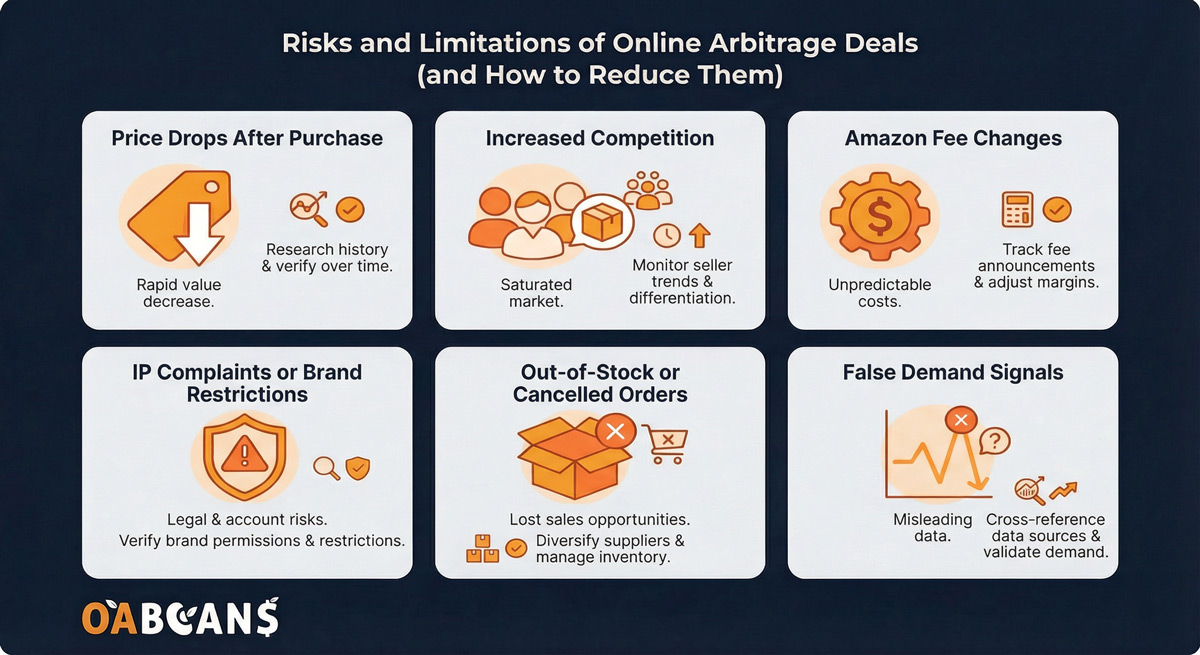
Like any other type of business, online arbitrage comes with its own risk. Here are the main limitations of this method, and some small tips for reducing them:
- Price drops after purchase
Prices can change fast, and a lower price after purchase means a loss for you. Reduce risk by checking price history and avoiding unstable listings. - Increased competition
Popular deals attract most sellers. Limit exposure by buying smaller test quantities first. - Amazon fee changes
Fees may shift without notice. Always leave a margin buffer when calculating profit. - IP complaints or brand restrictions
Some brands enforce hard restrictions. Verify brand history and category eligibility before sourcing. - Out-of-stock or cancelled orders
Retailers may cancel orders. Use reliable sources and avoid fragile stock levels. - False demand signals
Temporary rank drops can be misleading. Review longer-term data and velocity trends.
Step-by-Step Process of Finding Online Arbitrage Deals Manually
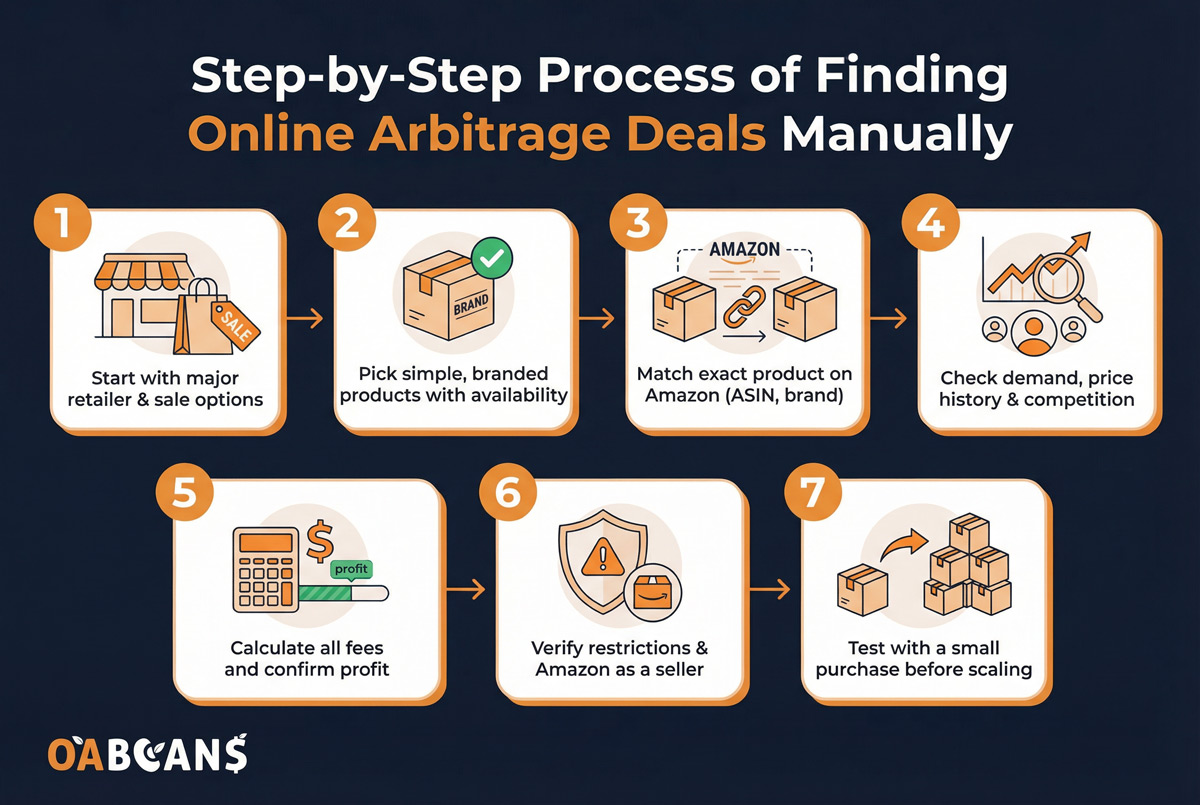
- Start with a major retailer and check sale or clearance options
- Pick simple, branded products with steady availability
- Match the exact product on Amazon (ASIN, brand, variation)
- Check demand, price history, and seller competition
- Calculate all fees and confirm profit
- Verify restrictions and Amazon as a seller
- Test with a small purchase before scaling
How to Analyse Amazon Product Pages for Profitable Deals
Want to know if the product page is built for profit? Start by confirming the exact product match. Check the brand, variation, and ASIN of the product. Now get to the Buy Box price, number of sellers, and whether Amazon is competing on the listing.
It’s important to review sales indicators like BSR trends and recent price stability. In the end, calculate all Amazon fees, VAT, and shipping costs to make sure that the profit margin is real and tangible.
How to Check Competition and Avoid Saturated Listings
Imagine you find a discounted fruit bowl that looks profitable, but when you open the Amazon listing, you see 25 active sellers in the buy box, including Amazon itself! Although tempting, this is usually a warning sign.
To make sure a listing is healthy for you, check how many sellers hold the Buy Box and how often the price drops. If Amazon sells the product directly, there will not be much profit in this deal, and you’d better move to the next one. Review seller count changes over time and avoid listings where new sellers emerge daily. Strong deals have limited competition most of the time, and their prices are stable.
Understanding Amazon Fees and Storage Costs
Working on Amazon is not expensive, but it’s not free either. If you don’t calculate costs and fees accurately, deals can turn into losses.
The first thing you need to know about is the referral fee, which varies by category. Also, keep an eye on the fulfilment fee if you use FBA. Some sellers also need to include inbound shipping, prep costs, and VAT in their list.
Storage fees are often overlooked but increase significantly during some time frames (like Q4), especially for slow-moving or oversized items. Always calculate fees using the current fee structure and assume realistic sell-through times (not best-case scenarios) to protect your margins.
Repricing Strategies for Online Arbitrage Sellers
Pricing, pricing, pricing! The first and most important thought of an Amazon seller. Here are some tips to do it smarter:
- Price competitively, not more hardcore. Undercutting too hard triggers rapid price drops, and it’s bad for the business in the long term.
- Focus on Buy Box rules: the metrics here are as important as price (if not more). Pay attention to seller metrics, fulfilment method, and stock availability.
- Use minimum and maximum price limits to protect margins and avoid race-to-the-bottom scenarios.
- Avoid constant repricing on listings where Amazon is an active seller.
- Reprice manually for low-volume or sensitive ASINs where automation can cause mistakes.
Review price history before setting rules. - Adjust prices based on stock levels and sell-through speed, instead of focusing only on competitor actions.
Advanced Product Research Metrics Most Sellers Ignore
Here are some metrics that are important, yet many sellers tend to overlook. Paying attention to them can set you apart:
- Buy Box rotation frequency
- Seller churn rate
- Price volatility range
- Sales velocity consistency
- Amazon in-stock frequency
- Review the velocity trend
- Offer count stability
- Historical fee changes
Brand Restrictions, IP Complaints, and Gating Issues Explained
As an Amazon seller, you’ll surely face some bumps in the road. Although completely natural, it’s best to know them before coming face to face. Here are the most important ones:
- Brand restrictions limit who can sell a brand, even if the products are genuine and retail sourced.
- IP complaints involve trademark or copyright claims and can remove listings immediately.
- Gating issues require Amazon approval to sell certain brands or categories, often needing invoices or account history.
Why Online Arbitrage Leads Services Save Time and Money
Instead of spending time going from store to store, you’ll get your product list easily and ready to use. Also, the risk has already been checked. Instead of scanning thousands of products, sellers focus on buying and scaling. This lowers sourcing errors, reduces wasted capital, and improves consistency.
How OABeans Leads Service Helps Amazon US & CA Sellers Find Profitable Deals
OABeans helps Amazon US and Canada sellers save time by delivering ready and usable online arbitrage leads. Leads are manually checked and researched, and they all come with key data such as buy price, sell price, estimated profit, ROI, and competition level. If there’s any risk, you’ll find a note explaining it in the lead.
OABeans is especially useful for sellers who want consistent deal flow, clearer decision-making, and fewer costly mistakes when sourcing in competitive US and CA marketplaces.
What Makes OABeans Online Arbitrage Deals Different from Other Lead Lists?
Unlike many other lead providers in the market, OABeans is not focused on volume; instead, it provides accuracy in context. Each deal is manually searched according to your needs, includes risk notes and has an Amazon presence alert. Looking at each lead, you can see “why it works” alongside numbers and statistics.
With OABeans leads, you’ll make more informed decisions with quality listings, just what you need in the competitive market of the US and CA.
How to Use Online Arbitrage Leads to Scale Your Amazon FBA Business
These leads can be a starting point, and a good one. But they’re not shortcuts. To make the best of them, it’s important to validate each lead against your own account restrictions, fees, and capital limits.
Buy small amounts, then reorder fast on winners before competition increases. Track sell-through speed and margin by brand or category. Over time, leads help you build repeatable buying patterns, recognising the best suppliers and creating a working flow.=
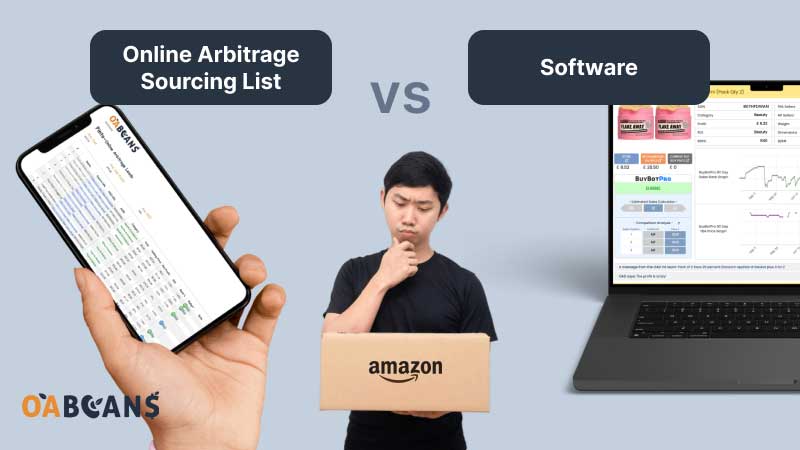
Automating Sourcing Workflows with Deal Lists and Software
- Step 1: Centralise your deal intake
Send every deal list to a single place (Google Sheet, Airtable, Notion) using a standard template. - Step 2: Add validation checkpoints
Auto-fill fees, ROI, and net profit fields; flag deals below your minimum thresholds. - Step 3: Run restriction and risk checks
Create fields for gating status, IP risk, and “Amazon as seller” to filter quickly. - Step 4: Prioritise by speed and margin
Sort by highest expected profit and fastest sell-through to protect cash flow. - Step 5: Create a test-buy queue
Mark deals with “test,” “reorder,” or “drop,” then tracks results. - Step 6: Build a reorder system
Set reminders for restocks and automate reorder notes for proven winners.
How to Build a Repeatable System for Online Arbitrage Deal Sourcing
Keep the consistency and make it a priority going forward. No matter how much you hunt for good deals, it’s being consistent that saves yo.u
Start by defining clear rules for what you buy: target ROI, minimum profit, acceptable competition, and risk tolerance. Use the same small set of retailers and brands so patterns become familiar over time. Standardise how you validate deals, calculate fees, and record results. Track what actually sells, how fast it moves, and where mistakes happen. Over time, this turns sourcing into a predictable workflow, enabling faster decision-making.
Common Mistakes Beginners Make in Online Arbitrage Deals
- Buying based only on ROI, and not checking real demand or sales consistency
- Ignoring Amazon fees, VAT, or storage costs
- Sourcing brands with known IP or restriction issues
- Competing directly with Amazon or saturated listings
- Overbuying on the first order instead of test buying
- Failing to match the exact ASIN, variation, or bundle configuration
- Trusting automated data without manual checks
Spreading capital across too many low-quality deals
Pro Tips to Maximise Profit Using OABeans Leads Service
- Treat each lead as a starting point, something to complete later. Don’t forget to recheck fees, restrictions, and current pricing on your own account.
- Test buy first, then scale onthe best products before listings get saturated.
- Prioritise leads with stable Buy Box behaviour and low seller churn
- Track performance by brand and retailer to identify repeatable sourcing patterns.
- Avoid leads where Amazon frequently jumps in and out as a seller.
Scaling from Side Hustle to Full-Time Business Using Online Arbitrage Deals
Most online arbitrage sellers begin as part-time operators, usually sourcing deals during evenings or weekends. The transition to a full-time business happens when sourcing turns into a predictable, recurrent process. This shift requires moving away from random deal chasing and building repeatable systems.
The first priority is cash flow control. Profits should be reinvested into fast-moving products instead of high ROI items with slow sell-through. Consistent sales velocity is more important than attractive margins on paper. As volume grows, tracking becomes essential. Sellers must closely monitor fees, storage exposure, and reorder timing to avoid capital being locked in unsold inventory.
The next stage is operational leverage. Deal lists, along with software tool, and clear sourcing rules, reduce manual effort for you, saving time and energy.
Finally, online arbitrage must be treated as a business, not a small side hustle. This means going all in: set monthly targets for the business, document processes, and plan for account health, taxes, and seasonality.
FAQ
- Are online arbitrage deals legal for Amazon FBA?
Yes, if items are authentic and policies are followed. - How much money do I need to get started with online arbitrage?
Start with £300–£1,000 to test, and then reinvest if needed. - Can I do online arbitrage without any paid tools?
Yes, but research is slower, and mistakes happen more often. - Do online arbitrage deals still work in 2025, or is the market saturated?
It works, but competition is higher, and margins are tighter. - How many deals per month do successful sellers usually purchase?
Typically, 20-100 deals monthly, depending on capital and speed. - Can beginners use OABeans leads service, or is it only for experienced sellers?
Beginners can use it, but must validate deals carefully. - Do I need an LLC ora company to start selling using online arbitrage deals?
No, but forming one helps taxes, liability, and scaling. - How long does it take to see a profit with online arbitrage deals?
Usually 2-8 weeks, depending on sell-through and reimbursement. - What happens if a deal from a lead service goes out of stock?
Skip it, or wait for restock, and move on. - Is OA better than wholesale or private label for new sellers?
OA is easier to start; wholesale and PL scale later.












11 replies on “What Are Online Arbitrage Leads?”
Amazon’s fulfillment options, such as FBA, streamline the shipping process for resellers, ensuring efficient and reliable delivery to customers.
With reselling, you can explore various sourcing channels such as retail stores, online marketplaces, and wholesalers, allowing you to find the best deals.
The FBA program provides sellers with access to Amazon’s comprehensive seller support, ensuring prompt assistance and resolution of any issues.
Reselling on Amazon provides access to valuable data insights and analytics that can help optimize pricing and inventory management.
By leveraging Amazon’s trusted brand and customer base, sellers can gain instant credibility and attract a larger audience.
I appreciate the ability to scale my online arbitrage business on Amazon. I can start small and gradually expand my inventory and reach as I gain experience and confidence.
By utilizing Amazon FBA, you can enjoy the benefits of Amazon’s extensive marketing and advertising efforts, reaching a broader audience.
Selling through Amazon FBA offers a seamless and convenient selling experience, backed by Amazon’s reputation for excellence in e-commerce.
Selling through Amazon’s platform provides online arbitrage sellers with a hassle-free returns process, promoting customer satisfaction and trust.
The scalability of Amazon reselling allows you to start small and gradually grow your business, reinvesting profits to expand your product inventory and sales volume.
I appreciate the customer service support provided by Amazon FBA. They handle any issues or inquiries from customers, ensuring a positive shopping experience.