
Quick answer: A suspended Amazon seller account has temporarily lost its selling privileges, usually over a fixable policy or performance problem, and can normally be reinstated with a good Plan of Action. A deactivated account is shut down more completely, often over identity verification, linked accounts, counterfeit or other serious issues, and is harder to get back. In practice, Amazon’s notices now often say “deactivated” for both, so what matters is the reason Amazon gives and whether your notice offers an appeal. You appeal from Account Health in Seller Central.
Amazon Seller Account Suspension
Before we talk about Amazon Account Deactivated vs Suspended, we should first know what exactly suspension is. When you sell something on Amazon, your account could get suspended for a number of reasons, many of which aren’t that scary. Usually, accounts won’t get suspended with a minor first offense (so you must read all terms of use).
To keep customers as happy as possible, Amazon can be pretty strict when it comes to account and sales standards. So, when one of your products is suspicious or causes health problems, bad feedbacks start piling up, your order rate falls dramatically, or you somehow don’t live up to Amazon’s standards, you might get suspended and suddenly can’t sell anymore. The good news is you CAN appeal to Amazon and get your account back. So, if you got the infamous ” Amazon account suspended” email, don’t panic just yet. There are ways to solve this problem.
Why Seller Accounts get Suspended?
As we said before, there are several reasons your seller account can get suspended. Here are some main reasons for this issue:
- Your account has the same name as other business accounts
- Your products don’t follow the terms you agreed to
- One of your products was reported as inauthentic
- You’re getting negative performance reviews
- You have posted restricted content or images on your page
- You sold a used product as new
- Your products were expired
- Your products were restricted
- You had a low order rate
- Your shipment was late or troublesome
- You don’t respond to buyers or respond late
- You are operating multiple accounts without Amazon’s approval
- You received intellectual property complaints (see our guide to handling an IP complaint on Amazon)
- Your identity or business verification could not be completed
How to Avoid Getting Your Seller Account Suspended?
First, you should pay close attention to what you read in terms of use. Most of the time, we read and accept these without knowing what we agree to. Each region might have different rules and terms. If you break any of these rules, suspension awaits you. Here are some suggestions for you to avoid getting suspended:

- Know what you are doing: Knowing Amazon rules and policies are excellent, but not enough. Amazon constantly updates its guidelines and informs you by email. So, paying attention to any email the platform sends you is essential.
- Talk to professionals: As a new seller on Amazon, seeking advice from experienced users helps you a lot. Many account suspensions on Amazon happen due to users’ ignorance. People who have sold before know what you should and shouldn’t do.
- Watch for warnings: When something happens and Amazon suspends your account, you usually get warnings beforehand. So keep an eye on your email and communicate with the emails. Keep the conversation respectful and professional.
- Manage your products: Many account suspensions happen due to low-quality sales. So, you probably won’t get suspended if you sell better products and get better reviews.
- Check Account Health every week: the Account Health page in Seller Central shows policy warnings, performance metrics and your Account Health Rating before they turn into a suspension. Our Amazon account health guide explains each metric.
- Keep invoices: buy from authorized suppliers and keep invoices, because authenticity and restricted product complaints are among the most common causes of suspension for resellers.
How to reinstate a suspended seller account?
A suspended account, by itself, could be very stressful, but reading about the problem and making a solid plan, helps you a lot. If you have received the dreadful suspension account, follow these steps:
- Get familiar with the situation: your first step should be to understand why this happened. This is also very important because it determines your next steps. The reason for suspension should be in the email, but if you can’t find it, you can contact support or get the help of a professional.
- Check your product information: After reading the notice from Amazon, you have to know what was wrong with your seller account. Thoroughly review your listings, products, and customer reviews. Find these in the “Customer metrics” section.
- Create a solid plan: After reviewing everything, it’s time to send Amazon a suspension appeal letter. It’s a good idea to write your plan step by step. Gather the data you need to convince amazon and explain how you will fix the issue. This letter needs a respectful but firm introduction, a brief list of reasons your account was suspended (So Amazon gets that you know the situation), a description of actions you have done since being suspended, and the ones you plan to do in the future, and a pleasant and friendly ending. In this step, you might need the help of a professional team to guide you.
- Send your POA: Once you have formulated your POA (Plan of Action), submit it in Seller Central. Open Performance > Account Health (or the notice in Performance Notifications) and click the appeal option next to the issue.
- Now open the email Amazon sent you and click on appeal. You will be presented with multiple options for appeal decisions. Pick what you think is best.
- Type in the POA, attach supporting documents (for example invoices, supplier letters or ID documents) and provide your contact information in case Amazon needs more details.
- Submit your appeal. It will be reviewed by Amazon seller performance.
- Wait patiently. Simple cases can be answered within days, while complex ones can take weeks. If Amazon asks for more information, reply with exactly what was requested. Reinstatement is never guaranteed, so make your first appeal as complete as possible.
Amazon Seller Account Deactivation
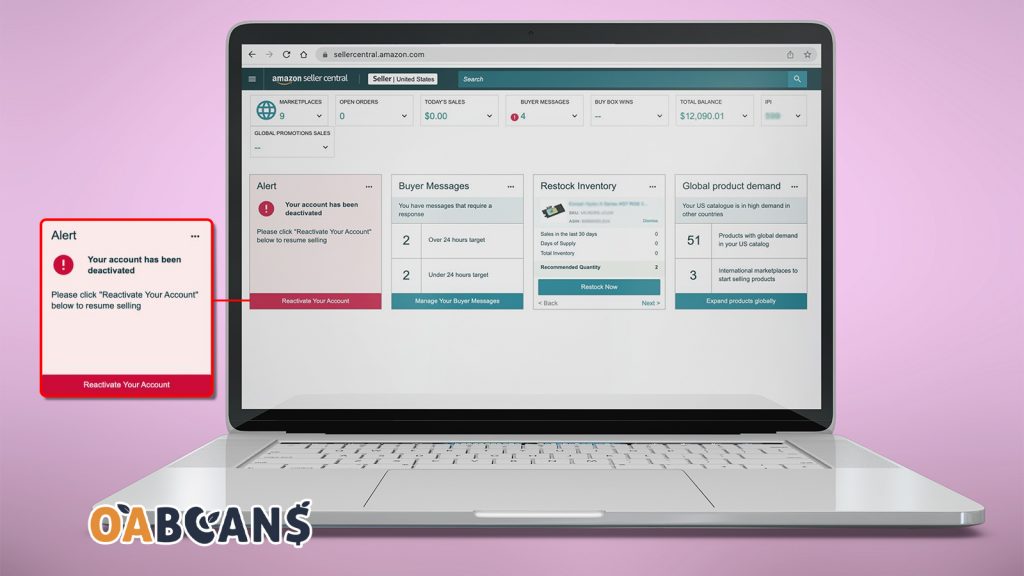
Another issue that some Amazon sellers face is deactivation. In deactivation, your account is revoked and you lose your seller privileges. In many cases you can still appeal through the “Reactivate your account” option in Account Health, but it usually takes stronger evidence than a standard suspension.
Why Amazon Seller Accounts get Deactivated?
When discussing an Amazon Account Deactivated vs Suspended, one should know when the account gets deactivated. Amazon keeps its community very safe and has zero tolerance for violations. Account deactivation may happen for these reasons:
- Selling prohibited items: many products are not permitted on Amazon. Things like drugs, alcohol, surveillance equipment, animals, and…
- Having multiple accounts: you generally need Amazon’s approval to operate more than one seller account in the same region, and accounts linked to a deactivated account can be deactivated too.
- Failing identity or business verification: if Amazon cannot verify your identity, address or business documents, the account can be deactivated until verification is completed.
- Selling counterfeit items: Amazon requires all products to be authentic. If you’re selling unauthentic ones, you will probably get deactivated.
Read More: 7 Brutal Mistakes That Arbitragers Need to Avoid
How to Resolve the Deactivation of Amazon Seller Account?
First of all, don’t rush into writing an appeal letter. Just like in the case of suspension, you need to gather information and know exactly why this has happened. After you collect the required information, follow these steps:
- Go to Amazon Seller Central, and then Performance. Now click Account Health.
- Now click Reactivate your account.
- Follow the instructions on the page. You should also include your documents and action plan for solving the issues.
- Click Submit to send your completed appeal to Amazon.
- Now wait for Amazon’s response.
What is the Difference Between Suspended & Deactivated Accounts?
While pretty similar, there are key differences between deactivated and suspended accounts on Amazon. Here is the complete list:
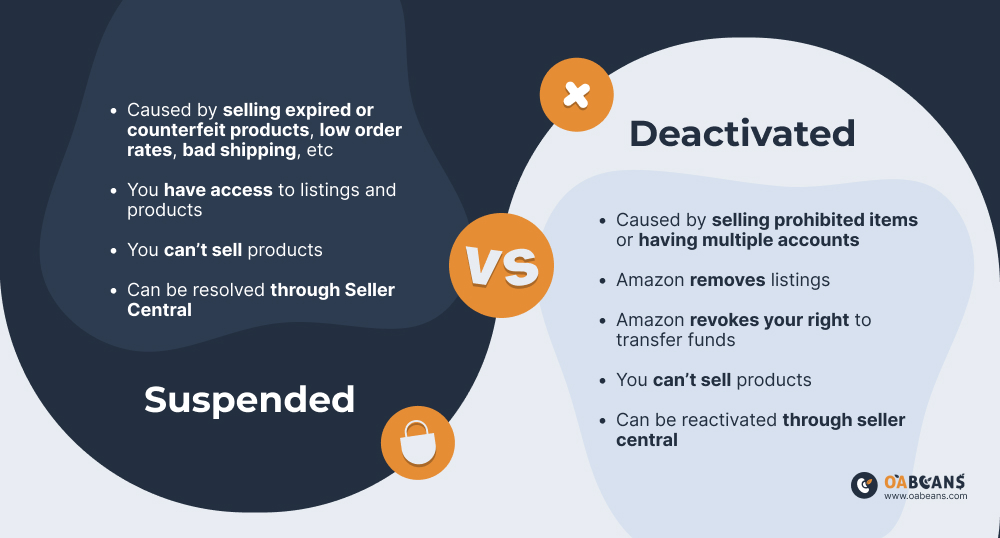
- Account Access: you can access your suspended account, but not fully. The Seller Central is still there, the notifications can be viewed and appeal submission is possible. Yet you can’t sell. In Deactivation, account access is fully revoked, and sellers cannot log in to their Seller Central account.
- The reason why: Amazon suspension happens mostly due to policy violations (things like selling counterfeit items or receiving a high number of negative reviews). It’s done as a warning and an opportunity to resolve the issues. On the other hand, deactivation is for more severe faults, such as fraudulent activities, or if issues remain unresolved after suspension.
- The Notification: in the case of suspension, the seller receives a detailed email explaining the reason for suspension, along with instructions on how to appeal. However, Deactivation notices are more definitive, telling the seller that the account is no longer active. Since it’s more permanent in nature, It may include information on remaining funds and the process for their disbursement.
- Funds: during a suspension or deactivation, Amazon can hold your account balance while it reviews the case. For deactivated accounts, funds may be held for an extended period before they are released, so keep your bank and tax details up to date.
- Appealing: suspended accounts can be appealed. You just have to submit a plan of action to Amazon, addressing the reasons for planning steps to prevent future issues. Yet deactivated accounts, usually have no appeal options or very limited ones. The appeal process in deactivation is complicated and often requires proving significant changes or resolving serious concerns.
- Listing Status: In suspension, Listings are removed from the marketplace temporarily. once the suspension is lifted and the issues are resolved, the seller gets their listing back. When an Amazon account is deactivated, listings are permanently removed, and the account cannot be used to sell on Amazon unless reactivation is granted, which is rare.
Final Thoughts
The modern market belongs to creative sellers, but this doesn’t mean you should ignore the rules. A professional seller on Amazon is a seller who knows precisely what to do and what NOT to do. So, to avoid suspension or deactivation, your primary action should be reading and following the terms of use. Walking a mile in your customer’s shoes is essential before underestimating their reviews. Try to understand their needs and help them have a pleasant shopping experience. Not only does this cause them to come back to you for more, but it will decrease the rate of negative reviews. We hope this article came in handy. For a step-by-step appeal guide, read our article on Amazon seller account suspension.
FAQs About Amazon Account Deactivation and Suspension
How long do Amazon account suspensions last?
There is no fixed length. A suspended or deactivated account stays inactive until Amazon accepts your appeal, so the timeline depends on how quickly you fix the root cause and submit a complete Plan of Action. Amazon does not publish a fixed limit on the number of appeals, but a weak appeal can slow the process down.
How long does it take for an Amazon seller account to be reactivated?
After you send the appeal, Amazon Seller Performance reviews it. Simple cases can be answered in a few days, while complex cases, or cases where Amazon asks for more information, can take several weeks.
What should I do immediately after my Amazon account is suspended?
Read the notice carefully, find the root cause in Account Health, fix it, and then submit a Plan of Action. Do not open a new seller account while the old one is suspended, because linked accounts can be deactivated as well.
Which violations most often lead to deactivation instead of suspension?
Linked accounts, failed identity verification, counterfeit complaints, repeated IP violations and falsified documents are the most common reasons for deactivation rather than a temporary suspension.
Can I access my funds while my account is suspended or deactivated?
Access is limited. Amazon can hold your balance while it reviews the case, and holds on deactivated accounts usually last longer. Once the account is reinstated, normal disbursements resume.
When should I escalate my appeal?
Only after you have submitted complete, compliant appeals and they were rejected or ignored. Escalating with the same weak appeal rarely helps; improve the Plan of Action first, and consider professional help for complex cases.